
A cat tree can look huge in a product photo and still have a top bed your Maine Coon can barely curl up in. Before choosing one, check the space your cat will actually use: the beds, platforms, cubby entrances and steps between levels. Then check how the tree needs to be assembled and secured.
The awkward part is that sellers often show the overall height and width more clearly than the bed measurements. Here’s how to work through those gaps before you spend money.
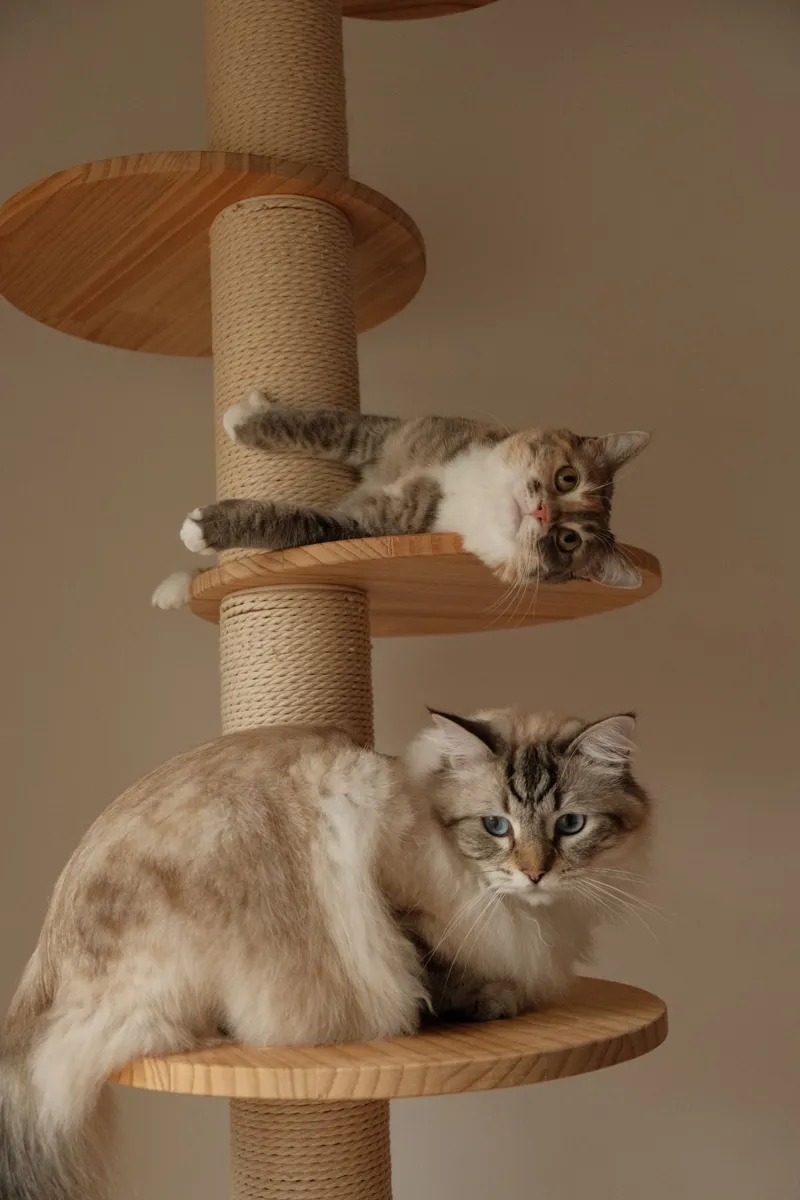
Start with your cat's resting space
Start with a place your cat already likes to sleep. When it gets up, measure the patch of bed or sofa it was using. Note whether it was curled up or stretched out, and write down the length and width. There’s no need to hold the cat still or stretch out its legs.
Those numbers give you a useful starting point for comparing beds. You’ll still need to check the tree’s construction and installation instructions separately.
If there’s a sleeping cubby, ask how much room is inside and how wide the entrance is. A box can look spacious from the outside while its walls and padding take up much of that space. Raised edges around an open bed can do the same thing.
Our Maine Coon size and growth guide explains why breed averages should not replace observations of your own cat.
Keep these measurements beside you while shopping
| What to record | Your measurement or question |
|---|---|
| Comfortable resting footprint | Body length and width in the recorded resting position |
| Main bed or perch | Usable surface inside any raised edges |
| Enclosed sleeping area | Internal length, width and height |
| Cubby entrance | Clear opening dimensions |
| Room space | Floor footprint plus clearance around the tree |
| Route between levels | Platforms and steps shown in the exact model's photographs or manual |
| Load information | Which component the stated limit applies to |
| Installation | Assembly steps and any supplied anchoring requirements |
Can’t find the bed dimensions? Ask the seller. If they’re still unavailable, leave that box marked “not supplied.” It’s better to know what you’re missing than to assume a bed will fit because the listing says “extra large.”
What the product dimensions actually tell you
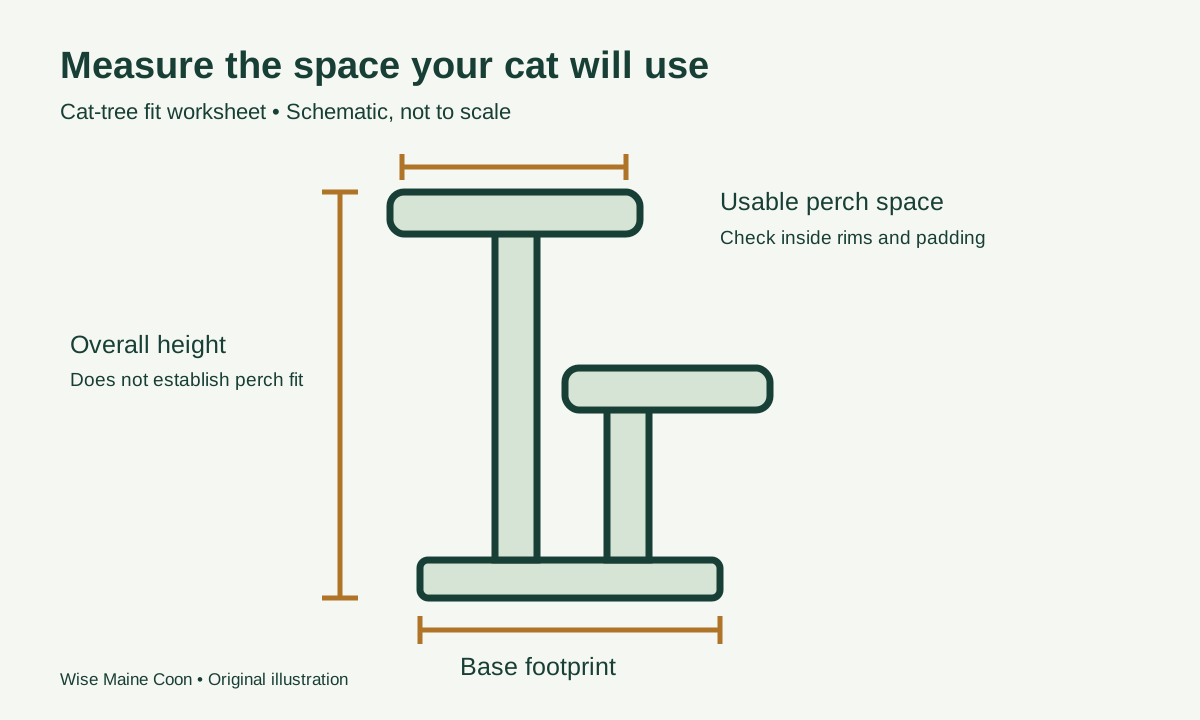
Take Catit’s Vesper range as an example. Its official page gives the overall measurements below. They help you compare the space each model takes up, but they don’t settle whether your cat fits the beds.
| Model | Overall measurements: height first, then the two footprint spans | What the overall measurement does not answer |
|---|---|---|
| Vesper Base | 33.2 × 22.1 × 22.1 inches | Usable perch area and cubby clearance |
| Vesper High Base | 47.8 × 22.1 × 22.1 inches | Whether the individual cat can rest and turn comfortably |
| Vesper High Base XL | 62.2 × 22.8 × 30.5 inches | Whether the extra height gives this cat a suitable route |
Source: Catit Vesper Base product specifications, checked 17 October 2026. The page lists overall measurements and materials. Confirm the precise variant and instructions before ordering.
Think about what you’re buying it for, too. If your cat mostly wants a place to nap by the window, a comfortable perch may answer that need. If you’re looking for several levels to explore, you have more measurements and a climbing route to check.
A perch measurement can change the shortlist
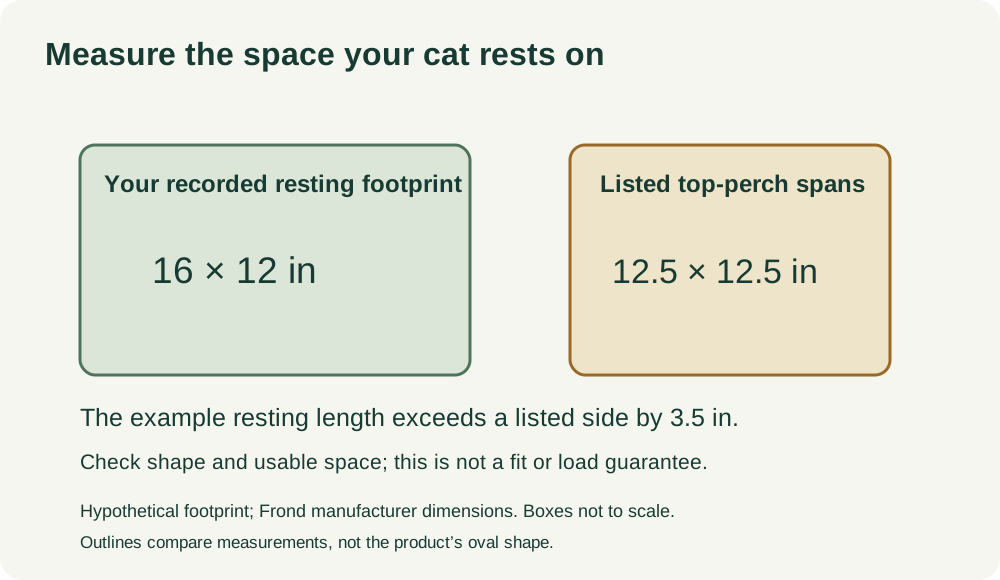
Here is a concrete example from Tuft & Paw’s Frond specifications, checked 17 October 2026. The listed tree envelope is 24 inches wide, 24 inches deep and 49 inches high. The top perch is 12.5 by 12.5 inches; the lower and middle perch surfaces, excluding the post, are 12.5 by 9.5 inches.
| Surface | Listed dimensions | Comparison with the example cat |
|---|---|---|
| Top perch | 12.5 × 12.5 inches | The 16-inch resting length exceeds the listed side by 3.5 inches. |
| Lower or middle perch | 12.5 × 9.5 inches, excluding post | The example footprint exceeds both listed spans in this orientation. |
This comparison does not prove the cat cannot perch there: it may curl differently, and an oval surface is not a rectangular bed. It does show why we would ask for a larger resting surface if our goal is to support that recorded sleeping position. The tree’s overall 24-inch width cannot answer that question.
Check the structure and installation instructions
A weight limit needs a little context. Is it for the hammock, a particular bed, or the whole tree? If the listing doesn’t say, ask. A limit for one component doesn’t tell you what the rest can support, and adding separate limits together won’t give you a reliable whole-tree capacity.
Cornell's guidance on scratching equipment calls for a sturdy structure and enough post height for a cat to stretch. For any tree, follow the manufacturer's assembly and fixing instructions, keep it on the specified surface, and inspect it for looseness or damage during use. Cornell's destructive-behavior guide provides the scratching guidance; it is not a product certification.
We haven’t tested these models in a home. The measurements here come from published specifications, so they can help you narrow your choices without pretending to guarantee the result.
Solid wood, thick pillars and a wide base: what should you require?
Record the actual construction rather than treating a material name as a safety certificate. Catit describes the Vesper range as MDF with laminate; Tuft & Paw lists plywood with ash veneer and solid ash connectors for Frond. Neither description alone establishes load capacity or stability for your cat.
A four-inch pillar diameter, a heavy base or a tall overall height is not a universal pass mark. Check post-to-base connections, the number and arrangement of supports, component load limits and required fixing points. Ask what surface the tree should stand on. For example, Frond’s manufacturer advises against using its optional feet on carpet.
| Check | What we know for Frond | Owner’s next step |
|---|---|---|
| Perch spans | 12.5 × 12.5 inches at top; 12.5 × 9.5 inches below | Compare with the cat’s resting position, allowing for surface shape |
| Materials | Plywood/ash veneer, ash connectors and sisal-covered column | Read assembly and ongoing inspection instructions |
| Component load capacity | No numeric component capacity established by our cited specifications | Ask the manufacturer; a pictured 12-pound cat is not a load test |
Do not add improvised ballast or drill an anchor into the product unless its maker provides an appropriate method. If a tree rocks, loosens or becomes damaged in use, stop access and resolve the assembly or support problem. We cannot claim that all ordinary trees will fail under a Maine Coon.
Which features matter most in your home?
| Main need | Compare first |
|---|---|
| A comfortable resting place | Usable bed dimensions and access |
| A compact setup | Base footprint and surrounding clearance |
| Several cats | Separate resting positions and clear component load information |
| Easier access | The route between levels and the individual cat's mobility |
| A scratching surface | Orientation, texture, usable post length and stability |
For a cat with pain or mobility changes, ask your veterinarian about appropriate access rather than choosing solely from a “senior cat” product label.
Questions owners often ask
Does a Maine Coon need an extra-large cat tree?
An extra-large label is a starting point for shopping, not a measurement. Compare usable surfaces and access with the individual cat. Two products using the same label can provide very different layouts.
Is a taller cat tower always better?
No. Decide what you want the tree to provide, then compare the route, resting space and installation requirements. Extra height does not solve a bed that is too small.
Can a cat tree stop furniture scratching?
A tree can provide a scratching option, but owning one does not ensure the cat will use it. Our furniture-scratching guide explains how location and surface preference affect the setup.
Before you order, you should be able to explain why that particular tree suits your cat and your room. If the answer rests mostly on the words “Maine Coon” in the product name, go back to the measurements. Our daily care guide covers the rest of the home setup.