
You’ve bought a scratching post, but your Maine Coon still heads for the sofa. Before buying another one, look at what the sofa offers: the angle, the texture and a spot your cat already visits. Put a steady alternative nearby and reward your cat when it uses it.
Scratching furniture is the behavior we’re addressing here. If your cat is scratching its own skin, has wounds or is grooming unusually, speak with your veterinarian instead of trying to solve it with a new post.
Why scratching happens
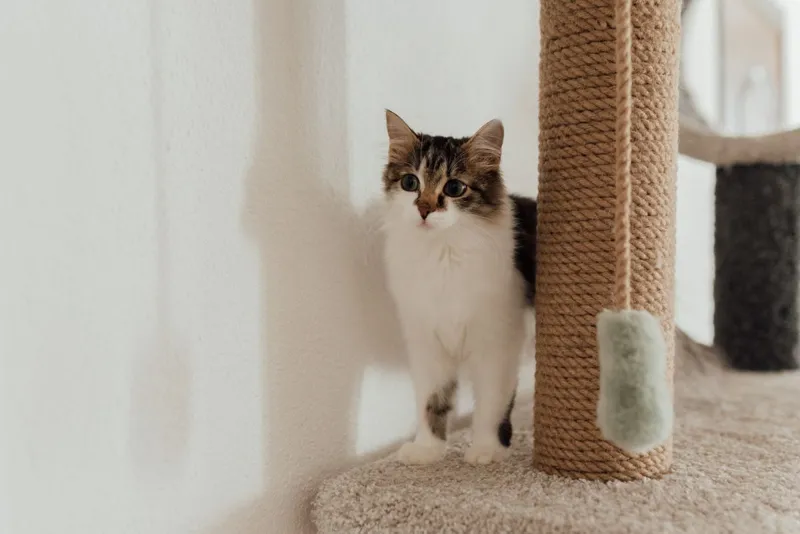
TICA describes scratching as a normal activity that supports stretching, claw maintenance and marking. It is not evidence that the cat is being spiteful.
A sofa edge might be in just the right place and stay put when the cat pulls against it. The scratcher, meanwhile, might wobble or sit in a room your cat rarely uses. That’s a setup worth changing before deciding your cat simply dislikes posts.
For a few days, notice where and when it happens. You’ll have a better starting point than “Maine Coons scratch everything,” and you’ll know what to compare when you change the setup.
Does your cat scratch up and down, or along the floor?
Cats Protection's scratching guidance recommends suitable scratching opportunities, including horizontal pads for cats that scratch floors or carpets.
| What the cat uses | First alternative to try |
|---|---|
| A vertical sofa edge | A steady upright scratching surface beside it |
| Carpet or a flat rug | A secure horizontal scratcher |
| Several rooms | Convenient scratching options near the recurring locations |
| A post that tips or moves | Equipment with a more suitable base and construction |
Then look at the surface. Your cat may respond differently to sisal, cardboard or another suitable material. The breed label on the packaging won’t tell you which one it likes.
Cornell advises a sturdy scratching structure and enough upright height for a full stretch. Place it near an area the cat already scratches. Cornell's destructive-behavior guide supports those setup principles; it does not supply a universal post height for this breed.
How tall and stable should the scratching post be?
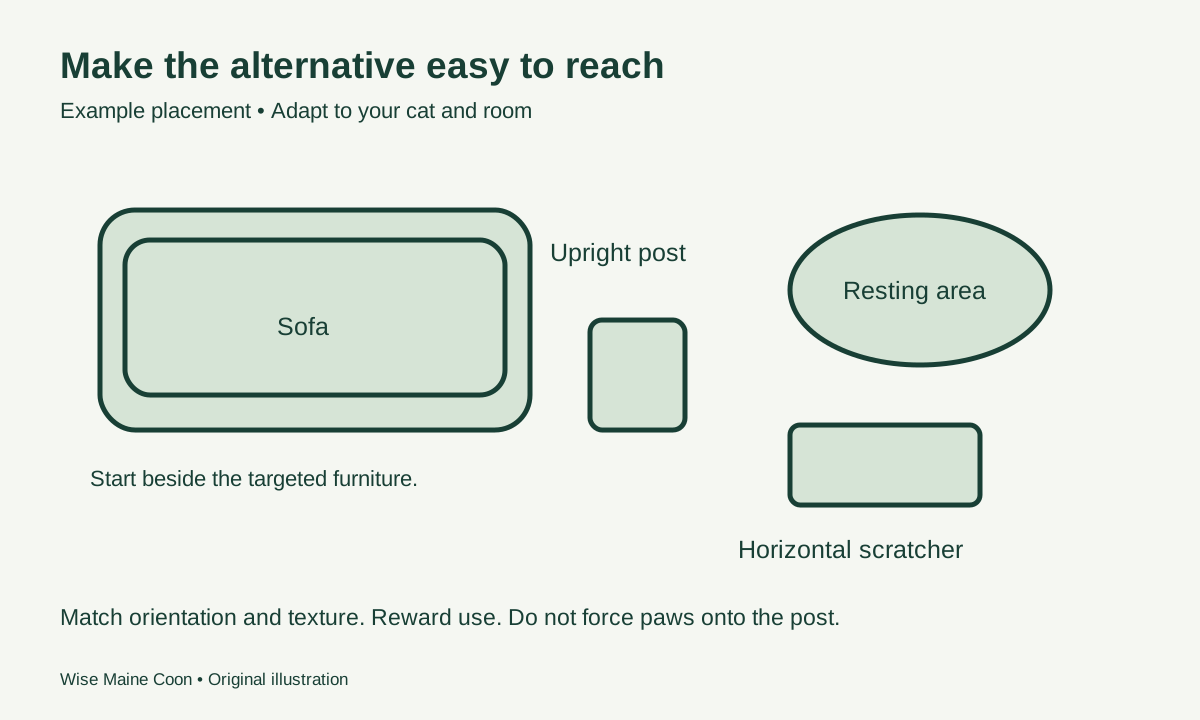
Watch a normal stretch at the furniture before selecting a replacement. Note the surface the paws reach and the direction of scratching. Use that observation to compare usable scratching height, not just the product’s total height including its cap or base. There is no verified breed-wide minimum height in the sources used here.
For a real specification example, Pioneer Pet’s beige SmartCat Ultimate Scratching Post, model 3832, advertises a 32-inch post and a 16 by 16-inch base. Its additional-information table lists 32.5 inches overall height. Those are different descriptions of the same product, not a reason to silently treat every inch as scratchable. Checked 17 October 2026.
Hypothetical situation: your cat reaches a sofa seam 30 inches above the floor, but its current post offers only 22 inches of usable scratching surface. That gives you a specific height gap to investigate. A taller option may help, but check where its usable surface begins, its stability, texture and location before buying. The cited model is an example, not our tested recommendation.
Put the alternative where it has a chance
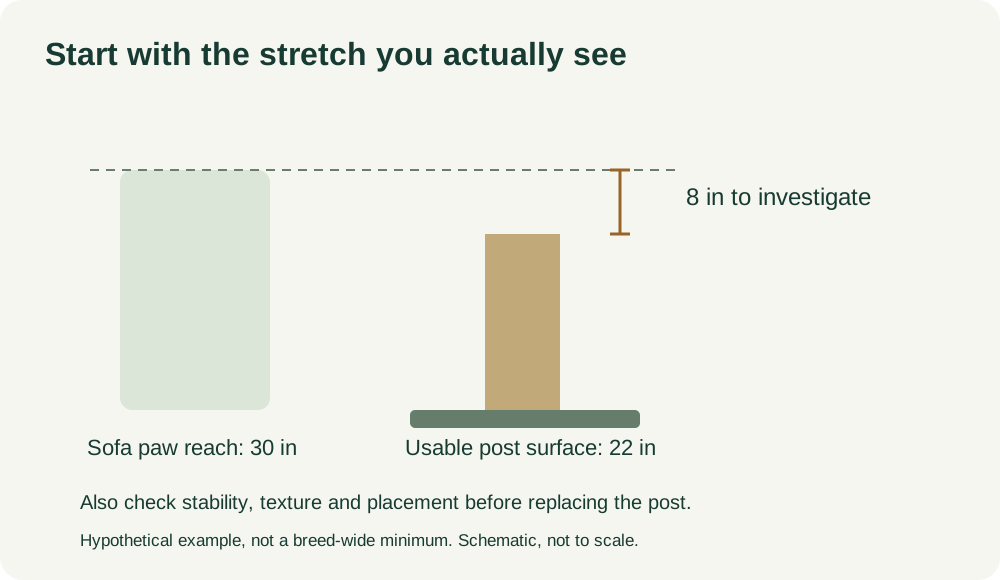
Start beside the furniture your cat already scratches. A lovely new post tucked away in the spare room may be easy for you to overlook, and just as easy for your cat to ignore.
Consider access from nearby resting places as well. Keep the post where the cat can reach it without being cornered, and avoid arranging furniture in a way that forces animals into conflict. The room diagram earlier in this guide illustrates one possible layout, not a rule for every room.
If you plan to use a cat tree as the scratching station, check its usable post length and stability separately from its beds. See our cat-tree fit guide for a measurement checklist.
Encourage the post without turning it into a battle
When your cat tries the new surface, offer a reward it enjoys and keep the moment calm. Resist the urge to show it what to do by moving its paws yourself. Cats Protection's behavior article cautions that rubbing a cat’s paws against a post can put it off.
Avoid shouting, hitting, spraying the cat or repeatedly forcing it toward the post. TICA recommends positive reinforcement rather than punishment in its furniture-protection guidance. You’re giving the cat a better place to do something normal, not teaching it to stop being a cat.
Protect the furniture while the cat learns. Use a secure cover that is suitable for the material and safe around the cat. Choose a solution that does not introduce loose parts it could swallow or snag. Test any furniture treatment in an inconspicuous area according to its instructions.
Keep a short observation log
You don’t need a complicated tracker. A few notes can help you see whether the new location or surface is making a difference:
| Date and location | Surface and direction | Alternative offered | What happened |
|---|---|---|---|
| Example only: Monday, sofa arm | Example: sofa edge, vertical | Post beside sofa | Furniture, post, both or neither |
If the post still gets ignored, check the basics again: does it move, is it conveniently placed, and does it offer the direction and texture the cat uses elsewhere? Change one thing, watch what happens, and make a note. That’s more useful than replacing the whole setup after one disappointing afternoon.
Keep the rest of the routine predictable and leave time for appropriate play. Our care guide helps you fit scratching opportunities into the wider home setup.
The post is still ignored: what should you change?
| Observed situation | First check | What to record |
|---|---|---|
| The post shifts when used | Assembly, base contact and manufacturer’s installation instructions; stop access if unstable | Where movement occurs and whether the cause is resolved |
| The cat scratches carpet beside an upright post | Offer a secure horizontal surface at that location | Which orientation it chooses |
| The cat reaches beyond the top | Compare its observed stretch with the usable surface | Reach height and where the scratchable section ends |
| A stable post sits unused in another room | Place an appropriate alternative beside the recurring scratching spot | Location, surface and voluntary use |
A heavier cat can put more demand on equipment, but body weight does not establish why it scratches the sofa. Location, orientation and surface preference remain relevant. For beds, base footprint and component limits on a combined scratching tower, use the cat-tree measurement example. If you are considering harness outings as enrichment, read the harness suitability and fit checks first; walks are optional and do not replace suitable scratching surfaces at home.
When to ask for help
Speak with your veterinarian if the change is sudden, the cat seems painful, or scratching appears alongside other changes in appetite, movement, elimination or interaction. Persistent problems may require advice from a qualified behavior professional rather than another shopping experiment.
Our personality guide covers behavior warning signs. Our grooming guide discusses nail care; trimming claws does not replace scratching opportunities.
Common questions
Will a scratching post stop every incident?
No single product can promise that. The useful test is whether an appropriate surface, placed conveniently, is being used more often. Keep recording the behavior and adjust the setup if needed.
Is a cat tree enough?
It may provide a suitable surface, but compare the actual post and location. A tower selected for sleeping space may not offer the scratching angle your cat prefers.
Should I throw away a worn post?
Inspect it for loose parts, instability and damage. Cornell notes that a worn scratching surface can be a sign of use, so appearance alone is not a reason to remove an otherwise serviceable favorite.