
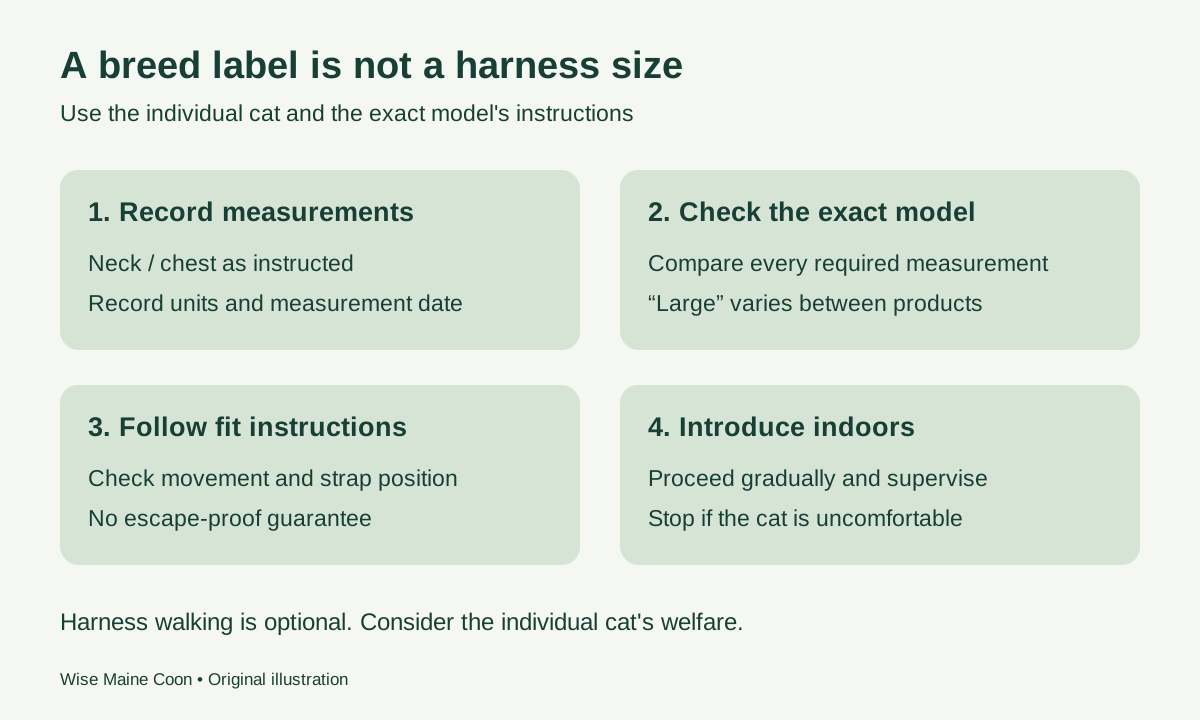
There isn’t one harness size that fits every Maine Coon. Start with your cat’s measurements, then compare them with the chart for the harness you’re considering. Even a size that looks right on paper needs a careful comfort check indoors.
Before shopping, there’s another question: would your cat enjoy this at all? Cats Protection advises against routine harness walks because restraint and unfamiliar surroundings can be stressful. A good fit matters, but it doesn’t make walking the right activity for every cat.
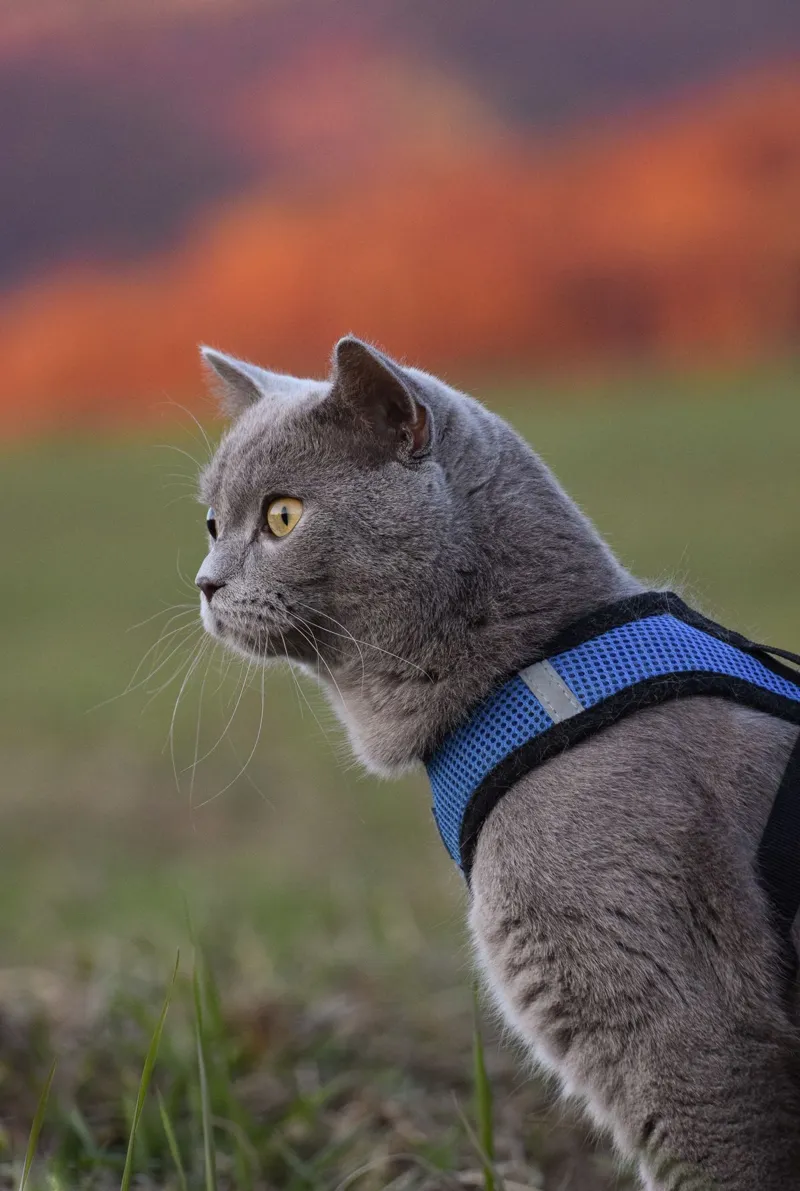
Start with the cat you have
It’s easy to hear Maine Coons described as “dog-like” and picture a cat happily walking beside you. Watch your own cat before making that leap. Does it investigate a new object and walk away calmly, or does it hide, freeze or struggle when something unfamiliar happens?
You don’t need to give those reactions a personality label. Use them to decide how cautiously to proceed, and whether indoor activities would be a better choice. Our personality guide explains why individual behavior matters more than the breed’s reputation.
Cats Protection's outdoor safety guidance also recommends gradual introduction when a harness is used. A secure enclosed outdoor area or an enriched indoor environment may be a more suitable option than a walk.
H-style, mesh vest or shoulder-strap harness?
A Maine Coon’s long coat can make the outline look broader than the body underneath. Do not choose a size from a photograph or add an arbitrary allowance for fur. Follow the exact model’s measuring and adjustment instructions, then check movement and strap position on your cat.
| Design example | What to examine | What the label cannot establish |
|---|---|---|
| H-style webbing | Separate neck and girth adjustment. LupinePet’s H-style model provides both. | Whether both openings adjust appropriately for your cat |
| Mesh-panel design | Panel position, front-leg clearance and neck/girth range. The RC Pets model below uses a chest panel with adjustable webbing. | That a larger fabric area prevents backing out |
| Shoulder-strap design | The model-specific chest slide, stopper and girth adjustment. PetSafe’s Come With Me Kitty instructions locate the slide on the breastbone, away from the throat, and use a stopper to position the shoulder straps. | That another brand should be fitted the same way |
These are construction differences, not a safety ranking. No fit assessment here establishes that a harness is escape-proof. If it shifts or the cat becomes distressed, stop and reassess indoors instead of pulling on the lead to test it.
Measure for the exact harness
Have a soft measuring tape ready and open the manufacturer’s diagram before you begin. “Chest” and “girth” aren’t useful numbers unless you measure at the points that chart expects. Write down the units, too. If your cat won’t cooperate, leave it for another calm moment.
| Record | Why it matters |
|---|---|
| Brand and exact model | Different models can use different charts |
| Neck circumference | Needed when the design has an adjustable neck opening |
| Chest or girth circumference | Measure at the location the manufacturer specifies |
| Units | Avoid comparing centimeters with an inch chart |
| Measurement date | A growing kitten needs reassessment |
| Return conditions | A chart cannot fully predict comfort on the individual cat |
For example, RC Pets lists these ranges for its Adventure Kitty Harness:
| Size | Girth | Neck |
|---|---|---|
| Small | 11 to 15 inches | 8 to 11 inches |
| Medium | 13 to 18 inches | 10 to 15 inches |
| Large | 15 to 22 inches | 12 to 17 inches |
The manufacturer instructs owners to use girth first, then check neck fit. Its fitting instructions allow one or two fingers beneath the adjusted straps. These details apply to this model, not every cat harness. RC Pets sizing and fitting instructions, checked 17 October 2026.
Use this table only for the named model. Another brand’s “large” may cover a different range. We haven’t tested this harness, and including its chart is not a recommendation to buy it.
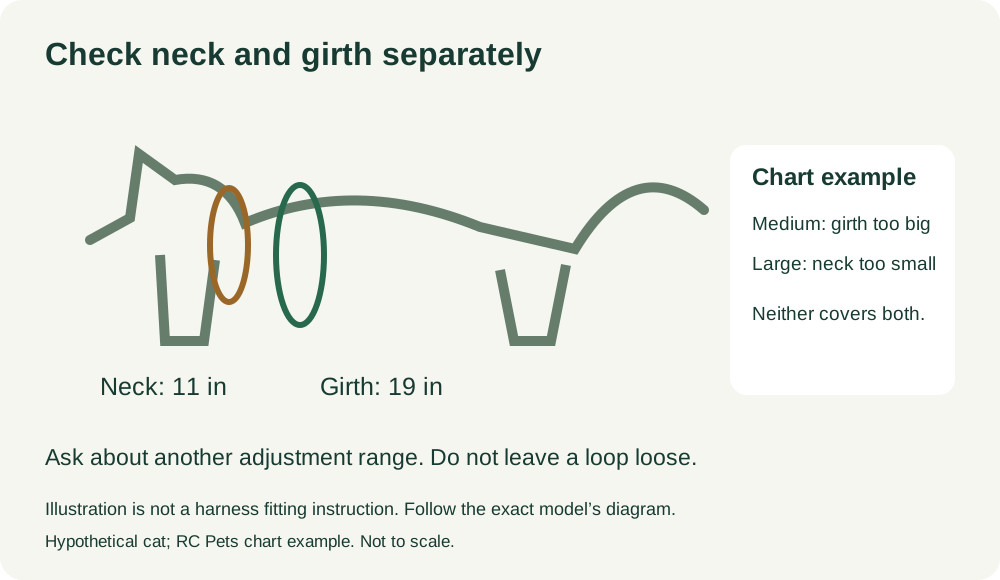
Worked example: neck and girth point to different sizes
Hypothetical measurements: a 19-inch girth and an 11-inch neck. In the RC Pets chart above, the girth is within Large’s 15 to 22-inch range, but the neck is below Large’s 12-inch minimum. Medium accommodates that neck measurement, but its girth stops at 18 inches. Neither size covers both measurements.
Do not solve that mismatch by leaving an opening loose or choosing on weight alone. Remeasure using this model’s instructions, then ask the manufacturer or consider a different adjustment range. A cat with a 19-inch girth and 13-inch neck would instead fall within both Large ranges on paper; it would still need an indoor fit check.
Inspect the fit before attaching a lead
Follow the product's instructions for strap position and fastening. Check that the cat can move normally and that straps do not rub or shift into an unintended position. A photograph of a standing cat cannot show everything that happens when it crouches, turns or backs away.
Give your cat room to move in a secure indoor space and keep watching the straps. Don’t frighten it or pull against it to see whether an “escape-proof” claim holds up. If you’re unsure about the fit, take the harness off and ask the manufacturer.
A kitten's fit can change during growth. Record measurements again rather than assuming the last purchase remains suitable. See our size and growth guide.
Take the introduction one step at a time
There’s no useful deadline for getting a cat comfortable with a harness. Keep early sessions short and let the cat’s response determine the next step. This checklist puts the gradual-introduction guidance into a simple order:
- Let the cat investigate the harness indoors without putting it on.
- Introduce brief contact only while the cat remains comfortable.
- Fit and remove it according to the instructions, pairing calm participation with an appropriate reward.
- Allow comfortable indoor movement before introducing the lead.
- Reassess whether outdoor use serves this cat at all.
If your cat looks uncomfortable, step back or stop. A cat standing frozen in a harness hasn’t necessarily accepted it. Pulling it forward won’t solve that discomfort, and there’s no reason to rush toward an outdoor outing.
Choosing indoor alternatives? Compare resting space in our cat-tree guide and use the scratching setup checklist for surfaces your cat can use at home.
Before any outdoor attempt
Cats Protection advises attaching the lead to a suitable cat harness rather than a collar, keeping the lead slack, and avoiding busy areas and dogs. It also recommends current microchip details and appropriate preventive care. Discuss vaccinations and parasite prevention with your veterinarian for your location.
Decide how you’ll end the outing before you start it. Stay with your cat, remove the harness after use, and never leave it tethered or wearing the equipment unattended.
Common fit questions
What size harness does an adult Maine Coon need?
There is no breed-wide size answer. Use the exact product chart and both required measurements. Body shape and adjustment range matter alongside the number on the label.
Is a dog harness suitable?
Begin with a design specifically made for cats and inspect its fit instructions. A size overlap does not demonstrate that the fastening and body layout suit a cat.
What if my cat refuses the harness?
Stop rather than forcing the activity. Harness walking is optional. Indoor play, climbing opportunities and an appropriate secure enclosure can offer other ways to enrich the routine.