
Two cats can both be described as tabby Maine Coons and still have noticeably different markings. One has broad swirls along its sides. Another has narrow stripes. A third has a more finely textured body coat, with clearer markings around its face and legs.
Tabby describes the markings on the coat. Names such as classic, mackerel and ticked describe how those markings look.
If you’re trying to understand a breeder’s description or identify the markings in a photograph, start with the side of the cat. A face portrait can be lovely, but it often leaves out the detail you need.
Tabby describes markings, not a separate breed
A tabby Maine Coon is a Maine Coon described as having tabby markings. The pattern name alone does not establish the breed.
That distinction matters when you see an unfamiliar long-haired cat. You can describe visible swirls or stripes without deciding that it must be a Maine Coon. Breed background and a coat description are separate questions.
Color is another part of the name. For example, “brown classic tabby” combines a color description with a pattern description. Adding “with white” gives another detail about the coat; it does not replace the underlying pattern.
Our colors-and-patterns overview explains how those parts fit together. Here, the focus is narrower: understanding the markings themselves.
Classic, mackerel and ticked: what to look for
The Cat Fanciers’ Association’s Maine Coon standard describes all three patterns. The table below turns the main visual differences into a practical starting point. It is not a show judging checklist.
| Pattern | Main feature to look for | Photograph that helps |
|---|---|---|
| Classic | Broad markings, including substantial rings or blotches on the sides | A clear side view showing most of the body |
| Mackerel | Narrower markings around the body | A side view where the flank is visible rather than hidden by a pose |
| Ticked | A finely ticked body coat without obvious body stripes or blotches; markings can remain on the face and legs | Both a whole-body view and a closer view of the coat |
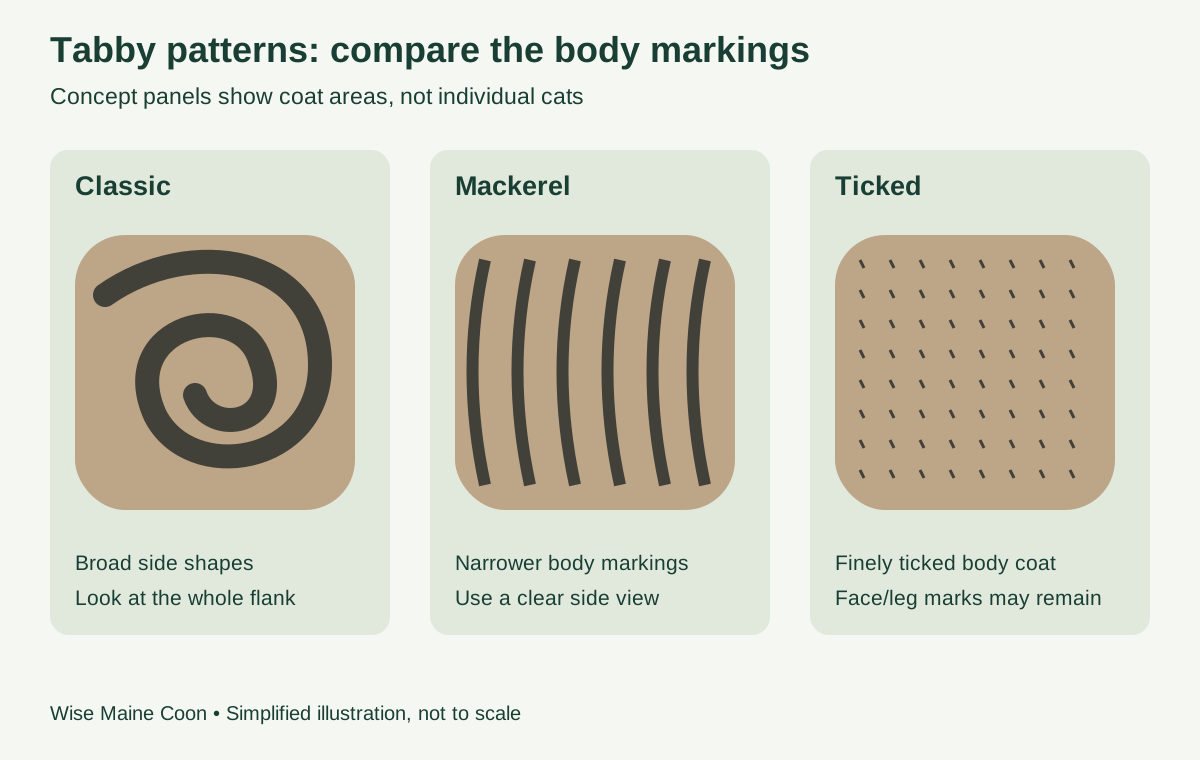
The photograph needs to show the feature you’re comparing. If a cat is curled up, its flank may be hidden. If the image shows only the head and chest, it cannot settle a question about side markings.
Classic tabby: look for the broader shapes
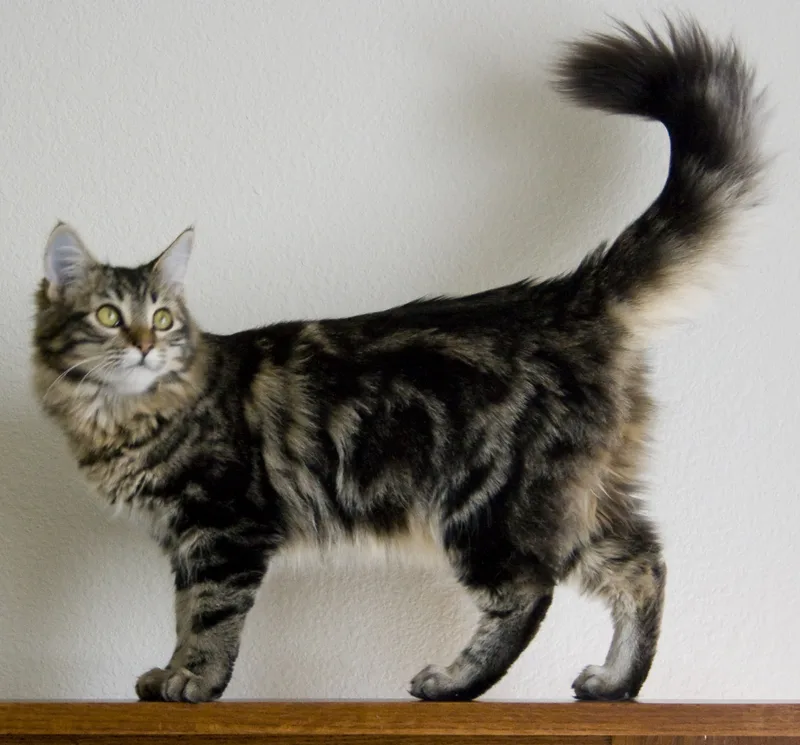

For a classic pattern, look beyond a single dark stripe. Notice how the larger markings are arranged across the side of the body.
Our selected classic-tabby photograph shows the cat standing sideways, so the broad markings are visible. The source labels it as a classic-tabby Maine Coon. That makes it a useful example of the appearance being discussed, although we have not reviewed that individual cat’s pedigree documents.
Mackerel tabby: look for narrower markings
For mackerel, compare the narrower body markings with the broader shapes in a classic example. A side photograph is more useful for this than a close-up of the face.
Don’t assume a photograph demonstrates the pattern just because its caption says “mackerel.” The label and the visible evidence do different jobs. A correctly labelled cat may be photographed in a position that hides the very markings the reader needs to see.
Ticked tabby: the body can look less obviously patterned
Ticked is the pattern most likely to confuse someone expecting every tabby to have large body stripes. The distinction concerns the appearance of the body coat, while markings may still show elsewhere.
The labelled schematic above illustrates this distinction. It shows the pattern concept rather than a photograph of an individual cat.
Does the forehead M identify a Maine Coon?
No. It is not a breed certificate.
CFA’s descriptions of classic and mackerel patterns include forehead markings resembling an M. That tells you something about a pattern description; it does not demonstrate an individual cat’s ancestry.
If the question is “What markings can I see?”, examine the coat. If the question is “What is this cat’s documented breed background?”, ask about its records. Trying to answer both from one facial feature creates unnecessary confusion.
Why different guides disagree about accepted patterns
Check which registry a guide is discussing before treating its list as universal.
CFA includes ticked tabby in its Maine Coon standard. The Maine Coon section of GCCF’s May 2025 Standard of Points lists classic and mackerel tabby. The Maine Coon Cat Club’s gallery explicitly notes that ticked and spotted Maine Coons cannot be shown in GCCF.
For anyone planning to show a cat, the relevant registry’s current rules matter. A general list of cat patterns cannot answer that showing question on its own.
For a reader simply learning coat terminology, the useful habit is to keep the pattern description and the registry’s eligibility rules separate.
A better way to compare a kitten’s photographs
You don’t need dozens of pictures. You need pictures that show the right details.
- Read the full description. Note the color, pattern and any “with white” wording rather than focusing on one word.
- Ask for a side view. Check whether the body markings are visible. If the cat’s position hides them, leave that part uncertain.
- Use the caption as a source label. A breeder or photographer’s identification provides context, but it should not be confused with an independent review of registration records.
- Ask what the records say. If a registered color or show eligibility matters to you, confirm it with the breeder and the named registry.
A helpful question is: “Could you show me where the classic or mackerel markings are visible in this photo?” It invites an explanation instead of turning the discussion into a guessing game.
Keep coat questions separate from care questions
This article compares appearances. It does not use a pattern name to predict a cat’s personality, health or adult size.
For practical care, use the individual cat’s needs and the appropriate advice. Our grooming guide covers managing the coat, and our size and growth guide covers the measurements that matter when planning space and equipment.
Common questions
Is classic tabby another name for brown tabby?
No. “Classic” describes the pattern, while “brown” describes a color. Read both parts of the coat name rather than using them interchangeably.
Can a ticked tabby have facial markings?
Yes. CFA’s description includes markings on the face and legs, even though the body lacks obvious stripes or blotches. The whole coat matters when comparing patterns.
Can I confirm the pattern from one photo?
Sometimes a suitable image makes the visible markings easy to describe. Other images leave important details hidden. State what you can see, and ask for another view when necessary.