
The kitten’s price is easy to notice. The food deliveries, litter refills and veterinary bills arrive later.
Prices checked October 21, 2026. Illustrative budgets below are clearly separated from advertised prices.
How much does a Maine Coon kitten cost?
Three US cattery websites checked for this article advertised the following standard kitten prices:
| Cattery and source | Advertised price | Checked |
|---|---|---|
| Canterbury Maine Coons, New Hampshire | $2,500 | October 21, 2026 |
| Mount Haven Cattery, Pennsylvania | $3,000 plus tax | October 21, 2026 |
| Coon’s Ransom, Washington | $3,500 | October 21, 2026 |
These are individual advertised prices, not a representative survey or endorsements of these breeders. Prices, included services and availability can change. Confirm a current written quote before making plans.
Ask what is included, what you must arrange yourself and whether a reservation payment counts toward the final price. For example, a hypothetical $500 deposit credited toward a $3,000 purchase leaves $2,500 to pay. Recording both the deposit and the full price as separate expenses would overstate your budget.
If you are adopting, replace the purchase price with the rescue’s actual fee and check which services it includes. If ancestry claims are unclear, read what can support Maine Coon ancestry.
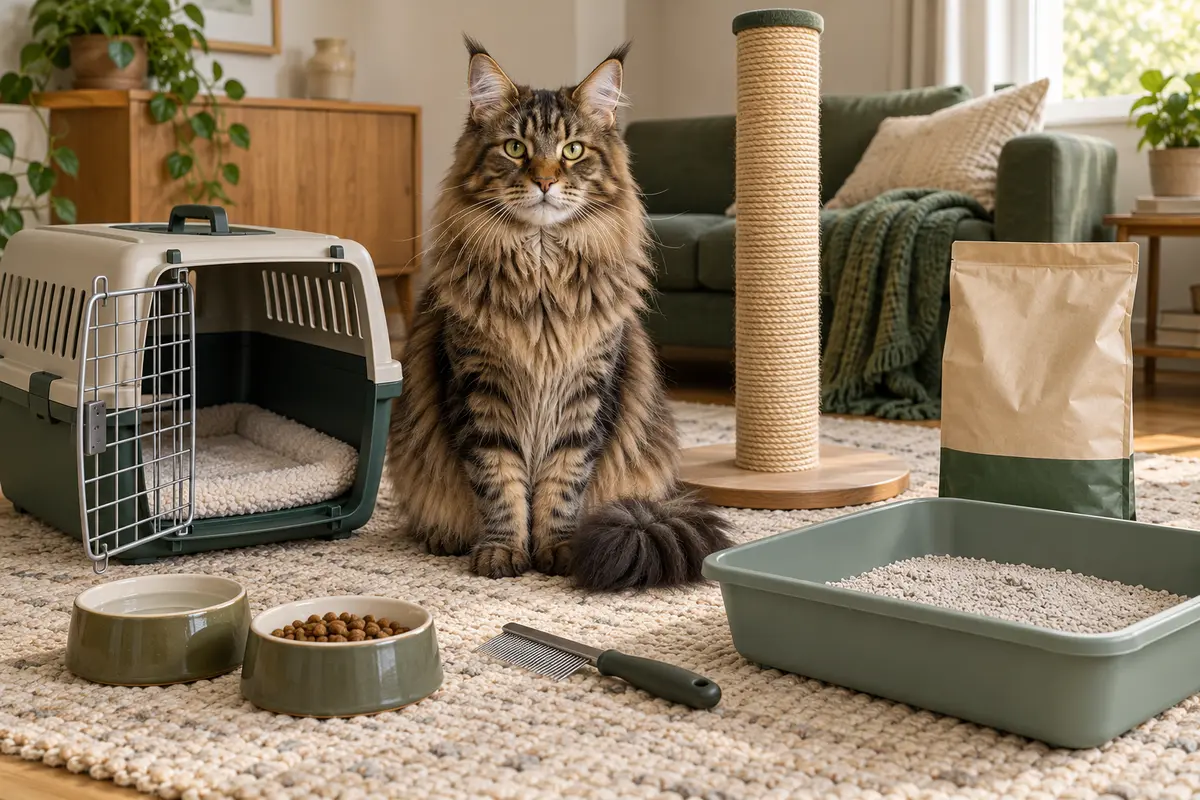
What supplies do you need before bringing one home?
Start with equipment that fits the cat and your home.
| Item | Check before buying |
|---|---|
| Carrier | Usable inside space, opening size and manufacturer’s weight limit |
| Litter tray | Inside floor measurements and room to turn |
| Scratching surface | Usable scratching area, stability and placement |
| Resting or climbing furniture | Platform dimensions, support and assembly requirements |
| Grooming tools | Suitability for the coat and comfort in your hand |
| Food and water bowls | Practical size, placement and ease of cleaning |
A product labelled “large” may still have a small sleeping platform or narrow entrance. Compare measurements using our cat-tree fit guide, scratching-furniture guide and litter-box size checker.
How do you calculate monthly ownership costs?
Price the food you intend to buy, estimate litter use and ask your veterinary clinic about planned care. Use this calculation:
Monthly spending plan = recurring purchases + annual planned costs divided by 12 + money set aside for unexpected costs.
The following is a hypothetical household example. These allowances demonstrate the arithmetic. They are not researched market averages or a recommended minimum.
| Category | Example monthly allowance |
|---|---|
| Food | $75 |
| Litter | $25 |
| Routine veterinary care fund | $30 |
| Insurance premium allowance | $40 |
| Toys and replacement supplies | $10 |
| Emergency savings contribution | $30 |
| Total allocated each month | $210 |
That household would allocate $2,520 over a year. Some money would pay current bills; some would remain in savings until needed. Replace every allowance with your own prices and quotes.
Professional grooming, boarding, pet sitting, dental procedures and unplanned treatment are additional considerations. Include them where relevant rather than assuming the example covers everything.
Calculate food costs by daily use
A bag’s purchase price tells you little about how long it will last. Suppose a chosen food costs $0.80 per serving and your feeding plan uses three servings daily: $0.80 × 3 × 30 = $72 for 30 days.
This is arithmetic only, not a portion or feeding schedule. Use the feeding plan appropriate for your cat, then calculate its cost. Our food guide and wet-food portion guide explain the feeding context.
What veterinary and unexpected costs should you budget for?
Ask your clinic for an estimate of the care planned for your cat’s first year. Compare that with the records provided by the breeder or rescue to see what has already been completed. Then decide how you would pay for an unexpected visit.
If considering insurance, compare the deductible, reimbursement percentage, limits, exclusions and payment process alongside the premium. ASPCA advises reading policy details carefully because plans differ.
Distinguish insurance premiums from savings. A savings contribution is money you retain; a premium is an expense. Both affect the cash you need each month.
Why older estimates need context
ASPCA’s published table gives a general cat first-year total of $1,904, but explicitly labels its figures as a 2021 update. Use it to identify expense categories, rather than presenting it as a current Maine Coon quote.
How do you work out the first-year total?
- Purchase or adoption fee.
- Equipment and initial care you still need.
- Twelve months of planned spending.
- Additional savings you want available, excluding savings already included in your monthly plan.
A hypothetical household paying $3,000 for a kitten, spending $450 on setup and allocating $210 monthly would need $5,970 during the first year, before any other expenses. That includes the savings contributions within the monthly allocation.
Run the calculation before committing to a kitten. It gives you time to adjust purchases, obtain better quotes and decide whether the ongoing commitment fits your household.
Still choosing a seller? Use our Maine Coon breeder checks before paying a deposit to review identity, records and written terms.