
Your cat has a fluffy tail, big paws and enough fur to fill a second cat. Someone has suggested a Maine Coon mix, and now you are wondering whether they might be right.
The useful question is: what do you actually know about your cat, and what are you guessing?
What evidence supports Maine Coon ancestry?
Before studying ear tufts, check your adoption paperwork, breeder documents or information from the previous owner. Look for the parents’ names, registration details and any pedigree documents.
If someone described your cat as a “Maine Coon mix,” ask what that description was based on. Did they know a parent, or were they judging the cat’s appearance?
Keep that distinction in your notes. “One parent has documented Maine Coon ancestry” is a different claim from “the shelter thought he looked like one.” Missing paperwork leaves the question open. It does not settle the answer either way.
Which physical traits should you compare?
The Cat Fanciers’ Association breed standard describes a combination of body shape, facial structure and coat characteristics. Consider them together instead of treating one feature as proof.
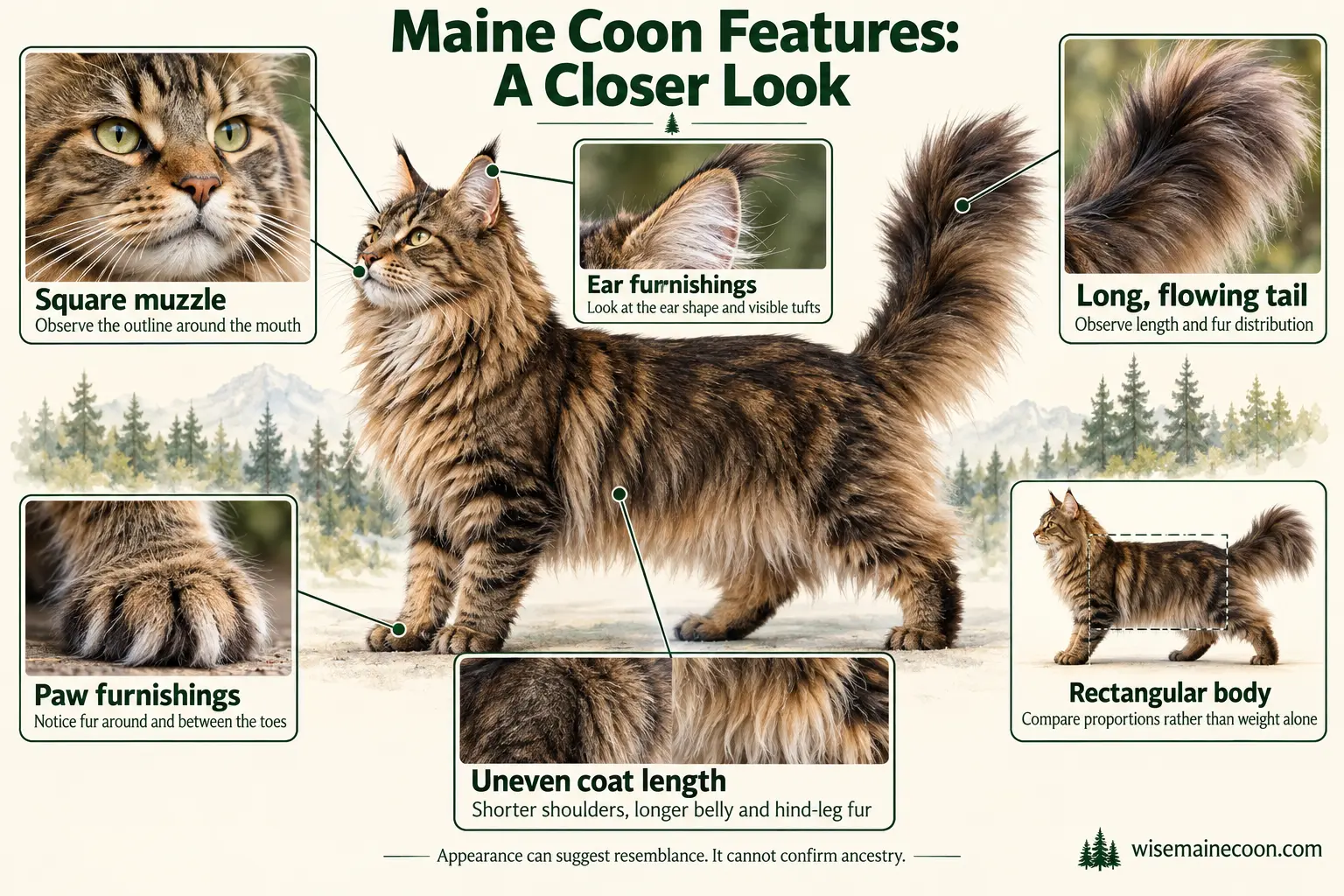
| Feature | What to look at | What it tells you |
|---|---|---|
| Muzzle | A visibly square outline around the mouth | Resemblance to the breed standard |
| Body | A long, rectangular build with substantial structure | More useful context than weight alone |
| Coat | Shorter shoulder fur and longer belly and hind-leg fur | A coat arrangement worth comparing |
| Tail | A long tail with flowing fur | A visible feature, not ancestry evidence |
| Ears and paws | Large ears and noticeable furnishings | Part of the overall appearance |
These are observations, not a scoring system. Matching four rows does not make a cat “80% Maine Coon.”
Take clear photographs from the front and side while your cat is relaxed. A close-up can help you examine the muzzle, while a standing side view shows proportions more clearly than a curled-up sleeping photo. Our size and growth guide provides context for measuring your cat.
What if your cat’s parents are unknown?
Imagine an adopted cat with a long coat, large paws and a full tail. The adoption record says “domestic longhair,” and nobody knows the parents.
You can describe that cat as having Maine Coon-like features. You cannot use those features to establish a Maine Coon parent or grandparent. This is a hypothetical example, not a documented case.
That uncertainty does not prevent you from making good care decisions. Measure the cat when choosing a harness or resting platform. Choose grooming tools for the coat you actually handle.
Can a DNA test identify a Maine Coon mix?
Read the particular test’s explanation before buying. An ancestry result, a parentage test and a test for a specific genetic variant answer different questions.
UC Davis explains that its discontinued cat ancestry test examined geographic origins and was not designed to establish a cat’s breed composition. That limitation applies to that test; it should not be presented as a finding about every commercial service.
Parentage testing works differently. UC Davis describes comparing an offspring’s DNA with possible parents. It requires candidate parents to compare, rather than identifying an unknown family from a photograph.
Before paying, ask the provider exactly what its result supports and what remains uncertain. Do not interpret a breed-related genetic variant as a pedigree certificate.
What should you do next?
Gather the records, compare the visible features and keep the conclusion proportionate to the evidence. If the family history remains unknown, “longhaired cat with Maine Coon-like features” is an honest description.
Your cat still needs equipment that fits, a manageable grooming routine and care suited to its individual needs. If you are planning for a new cat, use our ownership cost guide to separate purchase costs from ongoing care.
Choosing between breeds? Compare Maine Coon and Norwegian Forest Cat features and care, or Maine Coon and Ragdoll size and personality.