
Put a Maine Coon beside a Norwegian Forest Cat and the similarities are easy to see: substantial bodies, long tails and enough coat to make either look impressive.
A square muzzle can help you understand a breed standard. It cannot tell you whether a particular cat enjoys being carried or will settle beside your desk.
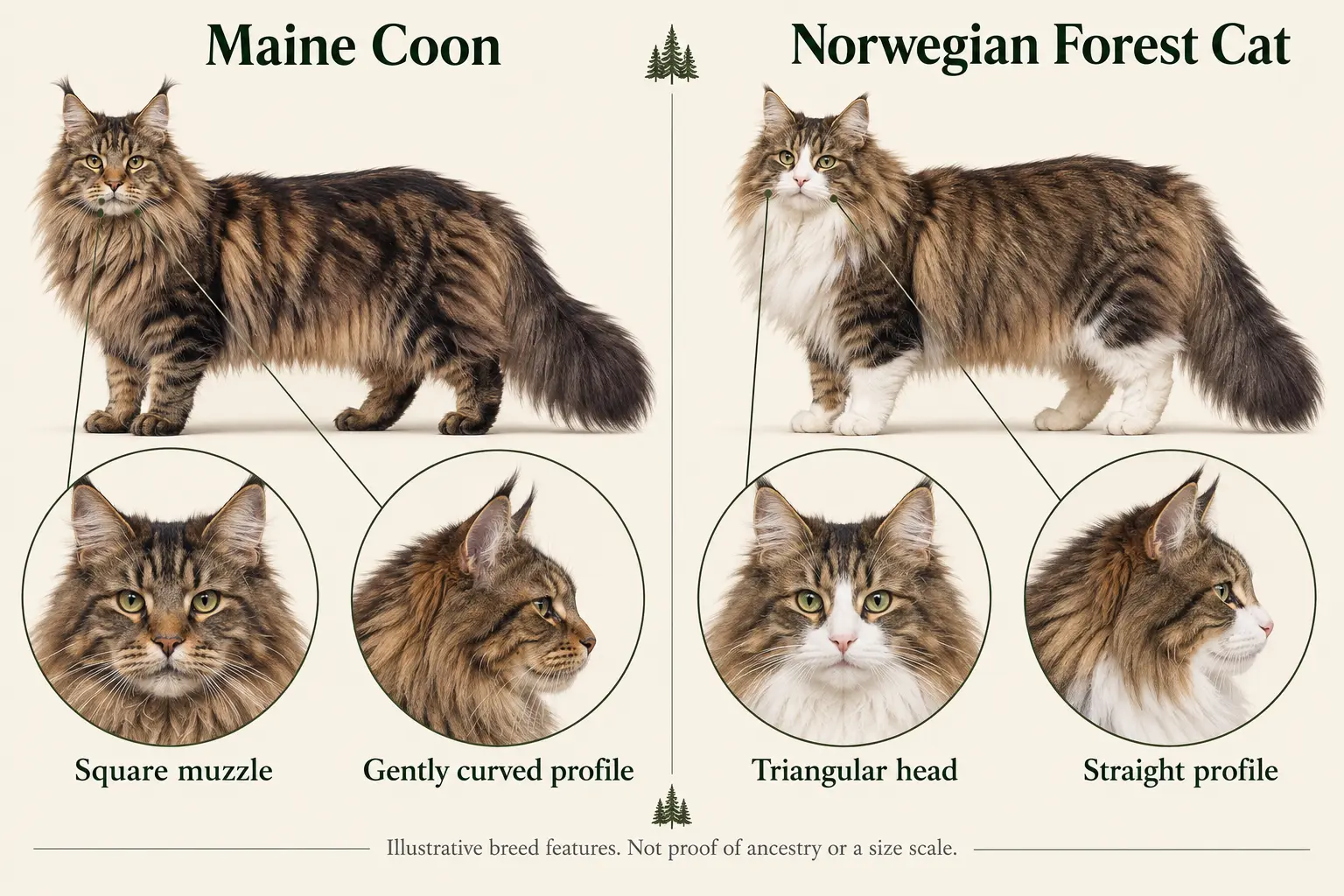
Maine Coon and Norwegian Forest Cat differences at a glance
| Feature | Maine Coon | Norwegian Forest Cat |
|---|---|---|
| Head and muzzle | Noticeably square muzzle | Triangular head; muzzle follows its outline |
| Nose profile | Slightly concave | Straight from brow ridge to nose tip |
| Body proportions | Long, rectangular appearance | Substantial, moderately long body; higher hindquarters |
| Coat | Shaggy, shorter at the shoulders | Dense undercoat with longer water-resistant guard hairs |
| Useful photo views | Muzzle close-up and body side view | Front head outline and nose side profile |
Physical descriptions follow CFA’s Maine Coon profile and its Norwegian Forest Cat standard. A photograph’s angle, posture and coat can make comparison harder.
How can you tell their faces apart?
Use two views: a relaxed front-facing photograph and a clear side profile. For a Maine Coon, examine the outline around the mouth. For a Norwegian Forest Cat, follow the overall head outline toward the chin, then look at the nose from the side.
Ear tufts and a fluffy tail are shared features. They are less useful on their own than the combination of head outline, muzzle and profile. CFA’s forest-breed comparison explains these shapes in more detail.
If your cat’s background is unknown, our ancestry guide explains the difference between resemblance and evidence. Comparing features cannot establish a pedigree.
Which breed is bigger?
CFA describes adult male Norwegian Forest Cats at approximately 12-16 pounds and females at 9-12 pounds. Its Maine Coon profile notes that mature males may reach or exceed 20 pounds, with females generally smaller. These are breed descriptions, not individual target weights.
The answer for a particular pair depends on their age, sex, build and condition. Do not judge a kitten against an adult, or use the largest online example to predict every cat’s future size.
For equipment, measure the cat. Two cats of the same weight can prefer different resting spaces. Compare usable platform area, carrier interiors and litter-tray floors. Our cat-tree fit guide explains what to check beyond advertised height.
How do their personalities compare?
TICA describes Maine Coons as affectionate companions involved in household activities. Its Norwegian Forest profile describes playful, interactive family companions. Those descriptions overlap.
A claim that one breed is always friendlier does not help you evaluate a particular cat. Ask the current carer for observations:
- Does the cat approach visitors or take time to observe?
- How does it respond to gentle handling and brushing?
- What does a normal play session look like?
- Has it lived comfortably with children or other animals?
For a hypothetical household with a quiet adult and a resident dog, the cat’s actual experience with dogs is more informative than a generic “family friendly” label. Plan the introduction around the individual animals.
Which needs more grooming?
CFA suggests combing Maine Coons two or three times weekly. For Norwegian Forest Cats, it recommends regular combing with extra attention during seasonal shedding, noting that some textures need more upkeep.
Start with the routine demonstrated by the breeder, rescue or foster carer, then check whether it keeps the coat comfortable and free of tangles. A seasonal coat change may require an adjustment. Our grooming guide explains a practical routine.
Do colour or kitten appearance settle the comparison?
No. The Norwegian Forest Cat standard includes multiple colours and patterns, including black and tabby descriptions. “Black,” “brown” or “orange” alone does not distinguish the breeds. Our coat-terms guide explains why colour and ancestry are separate questions.
For a kitten, ask to see its records and learn about its parents rather than expecting adult proportions and coat from an early photograph.
Which is a better fit for your home?
Compare the commitments you can make: regular play, suitable resting and climbing areas, coat care and a budget for ongoing needs. There is no universal winner.
Use our ownership-cost framework, replacing its Maine Coon purchase examples with actual quotes for the cats you are considering. Meet the individual cat where possible and ask about records, routines and behaviour.
Considering another large companion breed? Read our Maine Coon vs Ragdoll comparison, including a sourced adult-weight chart.
Sources and research notes
Breed-registry descriptions and standards were checked October 22, 2026. Search-question themes were reviewed from the supplied US-English AnswerThePublic export. That export is an idea source, not a verified search-volume estimate. Illustrations are explanatory; we have not assessed the cats in person.